
- Certification Provided Upon Completion
- Large Group Discounts Available
- Read More Below!
Emotional Intelligence Certification Training Online
$69.95
Description
Emotional Intelligence Training
Emotional Intelligence Training develops the ability to recognize emotions, understand emotional reactions, manage your own emotions, and respond effectively to the emotions of others. These emotional intelligence skills can improve communication, interpersonal relationships, decision making, conflict resolution, teamwork, leadership, and the way people respond during stressful or challenging interactions.
Emotional intelligence, sometimes described in terms of emotional quotient or EQ, combines several related emotional and social skills. Self-awareness helps you recognize your emotional state and reactions. Emotional regulation helps you manage those reactions. Empathy and social awareness improve your ability to understand other people, while communication and relationship skills help turn that awareness into more productive human interactions.
Our Emotional Intelligence for Crisis Intervention course provides focused emotional intelligence training that develops these concepts while also showing how they can be applied during conflict, crisis intervention, and de-escalation. It can be taken as a standalone emotional intelligence course or as complementary professional development for people who have already completed crisis prevention and intervention training.
What Is Emotional Intelligence Training?
Emotional Intelligence Training is the process of developing greater awareness and control of the emotional factors that influence behavior, communication, relationships, and decision making. Rather than simply learning a definition of emotional intelligence, training helps people recognize how emotions affect their own behavior and how their responses can influence the people around them.
Emotional intelligence development generally involves both internal and interpersonal skills. Internally, a person develops emotional awareness, self-awareness, motivation, and the ability to regulate challenging emotions. Interpersonally, emotional intelligence involves empathy, social awareness, communication skills, and the ability to recognize and respond appropriately to the feelings and social cues of others.
These abilities are particularly valuable when interactions become difficult. Greater awareness of your own emotions can help prevent an automatic emotional reaction from controlling your response, while empathy and interpersonal skills can help you recognize what another person may be experiencing. This creates more opportunities for thoughtful communication, problem solving, relationship building, and successful conflict resolution.
Emotional Intelligence Skills
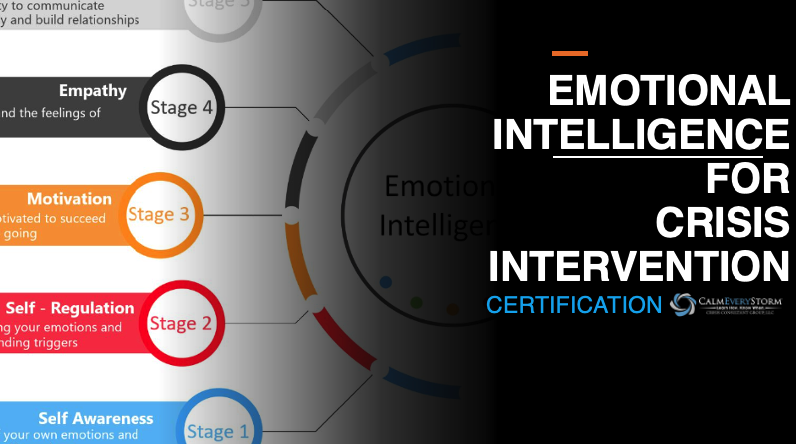
Emotional Intelligence Skills include self-awareness, emotional regulation, motivation, empathy, social awareness, communication, and interpersonal skills. The Emotional Intelligence for Crisis Intervention course focuses on five widely recognized core areas: Self-Awareness, Self-Regulation, Motivation, Empathy, and Social Skill.
These skills are interconnected. Self-awareness makes it easier to recognize emotional reactions as they occur. Emotional regulation provides a way to manage those reactions rather than acting on them automatically. Motivation can help maintain focus and constructive behavior, while empathy and social skills improve active listening, communication, rapport, and relationship management.
Developing these emotional and interpersonal soft skills can also support stress management, resilience, critical thinking, creativity, and decision making. In professional settings, emotional intelligence skills can influence human performance, how people communicate with coworkers, manage disagreements, respond to pressure, work within teams, and interact with people experiencing frustration, anxiety, anger, or distress.
Emotional Intelligence Certification Training
Emotional Intelligence Certification Training combines structured emotional intelligence education with a defined course-completion process and certificate. The Crisis Consultant Group Emotional Intelligence for Crisis Intervention course provides an online learning experience focused on understanding emotional intelligence, developing practical emotional skills, and applying those skills to real-world human interactions.
The course is designed to be concise and accessible while still covering the major emotional intelligence competencies that can influence communication and behavior. Participants examine self-awareness, self-regulation, motivation, empathy, and social skills and then connect those concepts to communication, relationships, teamwork, conflict, crisis intervention, and de-escalation.
Emotional intelligence training certification can provide a structured path for participants who want to develop these competencies while documenting successful completion of their training. Rather than treating emotional intelligence as an abstract psychological theory, the course emphasizes practical strategies that participants can relate to their personal relationships, professional relationships, workplace interactions, and responses to emotionally challenging situations.
Emotional Intelligence Certification
Emotional Intelligence Certification through this course provides participants with documented completion of the Emotional Intelligence for Crisis Intervention training. After completing the training requirements, participants receive a personalized certificate of completion that is immediately available in downloadable and printable format.
For someone comparing options for the best emotional intelligence certification, an important consideration is whether the course develops emotional intelligence competencies that can actually be applied outside the training environment. This course focuses on self-awareness, self-regulation, motivation, empathy, social skills, communication, relationships, conflict, and practical application rather than simply presenting emotional intelligence terminology.
The certification course can be completed independently by someone seeking emotional intelligence training or added to existing crisis prevention and intervention education. This makes it useful both as standalone personal or professional development and as complementary training for people whose work involves communication, conflict, difficult interactions, or crisis situations.
The emphasis is on practical emotional intelligence competencies rather than simply memorizing terminology. Participants learn how awareness of emotions, emotional regulation, empathy, communication, and social skills can influence their own behavior and the outcome of interactions with other people.
Emotional Intelligence Certification Course
Emotional Intelligence Certification Course content introduces the major components of emotional intelligence and then develops their practical application. The training consists of just under 40 minutes of narrated PowerPoint multimedia, followed by a short assignment and brief written test upon completion.
This emotional intelligence training course moves from understanding emotional intelligence into recognizing how emotional awareness affects behavior and human interactions. Participants examine the five core areas of Self-Awareness, Self-Regulation, Motivation, Empathy, and Social Skill and consider how these abilities can improve communication, rapport, relationships, teamwork, and responses to challenging situations.
Unlike emotional intelligence training courses designed around a single workplace role, the concepts taught here have broad personal and professional application. Emotional intelligence can affect leadership effectiveness, team dynamics, employee engagement, job performance, professional success, relationships, and the ability to communicate constructively when emotions are elevated.
Successful completion results in a personalized certificate of completion. The online format makes the course a practical option for individuals seeking focused emotional intelligence training as well as organizations interested in adding emotional intelligence education to broader staff development or crisis intervention training.
Emotional Intelligence Training Online
Emotional Intelligence Training Online makes it possible to complete this focused course without attending an in-person training session. The Emotional Intelligence for Crisis Intervention course delivers its instructional content online through narrated multimedia, allowing participants to work through the emotional intelligence material and complete the required assignment and written test remotely.
Online emotional intelligence training is particularly useful when learners need a convenient professional-development option that can fit around existing work and training responsibilities. The course provides a structured learning experience while remaining concise enough to be used as standalone training or combined with other crisis prevention and intervention education.
Emotional Intelligence Certification Online
Emotional Intelligence Certification Online allows participants to complete the Emotional Intelligence for Crisis Intervention course and receive their certificate without attending a classroom program. The instructional portion is just under 40 minutes and is followed by the course assignment and brief written test.
Once the course requirements are successfully completed, the personalized certificate of completion is immediately available for downloading and printing. This online certification format provides a straightforward way for individuals to document completion of emotional intelligence training while developing skills that can be applied to communication, relationships, conflict, teamwork, and crisis intervention.
Online Emotional Intelligence Course
Online Emotional Intelligence Course content should do more than provide definitions of emotions or EQ. The purpose of this course is to help participants understand the relationship between emotional awareness and behavior and then apply that understanding to interactions with other people.
The emotional intelligence online program explores how self-awareness and emotional regulation affect personal reactions, how empathy and social awareness affect understanding of others, and how communication and interpersonal skills can change the direction of an interaction. These concepts are especially important when conversations involve disagreement, stress, frustration, or escalating emotions.
People considering emotional intelligence courses online or comparing different emotional intelligence online courses may have different professional and personal goals. The practical value of online training comes from connecting course content to behaviors participants can recognize and apply in real interactions. For that reason, the learning process here connects emotional intelligence concepts with communication, relationships, conflict, teamwork, stress, and decision making.
When evaluating the best emotional intelligence courses online for a particular need, participants may also want to consider the subject emphasis, course content, completion requirements, online learning format, and practical application of the material. This course specifically combines emotional intelligence education with its application to challenging interactions, crisis intervention, and de-escalation.
For organizations, courses on emotional intelligence can also complement broader learning and development programs, leadership development, talent development, and staff training programs. Large-group discounts are available for groups of 10 or more, and organizations should contact Crisis Consultant Group prior to purchasing group training.
Self-Awareness And Emotional Regulation
Self-Awareness and Emotional Regulation form an important foundation for emotional intelligence. Self-awareness involves recognizing your own emotions, emotional habits, triggers, perceptions, and reactions. Emotional regulation involves what happens next: how effectively you manage those emotions and choose your response.
A person who recognizes an emotional reaction while it is happening has an opportunity to respond differently. Instead of allowing anger, anxiety, frustration, or stress to automatically determine behavior, emotional awareness creates space for reflection, cognitive skills, and more deliberate decision making.
That ability becomes particularly important during conflict or crisis. Your emotional state can affect your tone of voice, body language, listening, judgment, and communication. Recognizing and regulating your own reaction can help you remain focused on the interaction rather than becoming another source of escalation.
Understanding And Managing Emotions
Understanding and managing emotions involves recognizing what you are feeling, considering why the reaction is occurring, and choosing how to respond. This does not mean ignoring negative emotions. Anger, fear, anxiety, frustration, and stress can provide important information, but they do not have to control the next action.
Emotional regulation, mindfulness, coping strategies, and cognitive reappraisal can all support a more thoughtful response to challenging emotions. Reconsidering how a situation is interpreted, for example, may change the intensity of the emotional reaction and make constructive communication easier.
Many concepts associated with positive psychology, behavioral science, and the study of emotional well-being also emphasize the value of awareness, reflection, adaptive coping, and constructive behavior. Within emotional intelligence training, these ideas become practical tools for recognizing emotional patterns and considering more effective responses.
Over time, greater emotional awareness can contribute to resilience, emotional well-being, self-confidence, and improved stress management. It can also make it easier to recognize emotional patterns and develop new behaviors when an existing response is creating poor results.
Empathy, Communication And Interpersonal Skills
Empathy, Communication and Interpersonal Skills move emotional intelligence beyond understanding yourself and into understanding other people. Empathy involves recognizing and considering another person’s emotional experience, while interpersonal and communication skills determine how effectively that understanding is expressed during an interaction.
Emotional intelligence can improve communication because people are not responding only to words. Tone, facial expression, body language, nonverbal cues, emotional state, and the existing relationship can all influence how a message is interpreted. Greater social awareness makes it easier to recognize those factors and adjust communication accordingly.
Active Listening And Social Awareness
Active Listening and Social Awareness help a person understand both what someone is saying and what may be occurring beneath the words. Active listening requires attention rather than simply waiting for an opportunity to respond. Social awareness adds sensitivity to emotional reactions, social cues, nonverbal communication, and changes in the interaction.
Empathy strengthens this process by encouraging consideration of another person’s perspective and feelings. Curiosity can also be valuable: instead of immediately assuming why another person is behaving a certain way, asking questions and listening can provide information that changes how the interaction is understood.
A response does not have to agree with someone’s position to demonstrate that the person has been heard and understood. Listening, empathy, perception, positive feedback, and constructive communication can help build rapport, trust, and credibility. They also provide better information for deciding what to say or do next.
Relationships And Conflict Resolution
Relationships and Conflict Resolution are strongly influenced by emotional intelligence because conflict often involves both the issue being discussed and the emotional responses surrounding it. Self-awareness helps a person recognize their own reaction, while empathy and social awareness help identify what may be driving the other person’s behavior.
Communication skills, active listening, assertiveness, trust, integrity, and relationship management can then be used to address disagreement without unnecessarily increasing tension. This can support healthier personal relationships, stronger professional relationships, and more productive workplace interactions.
These same abilities are relevant to de-escalation. Recognizing emotional cues, managing your own reactions, communicating clearly, listening actively, and building rapport can help create conditions in which an escalating interaction has a better opportunity to move toward resolution.
Emotional Intelligence In The Workplace
Emotional Intelligence in the Workplace affects how employees, managers, leaders, and team members communicate, respond to pressure, handle disagreements, and maintain professional relationships. Technical skills may determine whether someone can perform a particular task, while emotional intelligence and other interpersonal soft skills can influence human performance and how effectively that work is performed with other people.
Greater self-awareness and emotional regulation can improve responses to feedback, stress, mistakes, and conflict. Empathy and social awareness can improve interactions with coworkers and customers. Communication and relationship-management skills can contribute to teamwork, employee engagement, employee satisfaction, job satisfaction, organizational performance, and a more productive work environment.
These relationships are also important within organizational psychology because individual behavior and interpersonal relationships influence teams and organizations. Emotional intelligence can contribute to positive change by helping people recognize how their own behavior affects coworkers, workplace relationships, team dynamics, and organizational culture.
Leadership And Management Skills
Leadership and Management Skills are closely connected to emotional intelligence because leaders influence both tasks and people. Self-aware leaders are better positioned to recognize how their own emotional state, communication style, leadership style, and behavior affect employees and direct reports.
Empathy and social awareness can help managers recognize concerns within a team, while active listening and communication skills can improve feedback and difficult conversations. Emotional regulation can also support clearer decision making when leaders are under pressure or dealing with conflict.
Emotional intelligence can therefore become part of leadership development and executive development by strengthening core competencies involving self-awareness, communication, relationships, judgment, and the management of people. These capabilities can influence leadership effectiveness, employee engagement, team performance, and organizational success.
Developing these abilities can strengthen leadership effectiveness without requiring leaders to avoid difficult decisions. Emotional intelligence provides additional information and interpersonal tools that can help leaders communicate those decisions, maintain trust, and manage relationships more effectively.
Teamwork, Collaboration And Employee Engagement
Teamwork, Collaboration and Employee Engagement depend heavily on human interactions. Teams function more effectively when members can communicate openly, listen to one another, manage disagreement, recognize social cues, and maintain productive professional relationships.
Emotional intelligence can support team effectiveness by helping individuals understand how their behavior affects other team members. Empathy can improve perspective-taking, emotional regulation can reduce reactive conflict, and communication skills can make collaboration and problem solving more productive.
These skills can also contribute to psychological safety and a healthier organizational culture by making it easier for employees to communicate concerns, receive feedback, discuss mistakes, and participate in difficult conversations without unnecessary interpersonal escalation. Stronger team dynamics can, in turn, support employee satisfaction, engagement, professional success, and higher performance.
Stress Management, Resilience And Decision Making
Stress Management, Resilience and Decision Making are connected to emotional intelligence because stress can change how people perceive situations, process information, communicate, and react to other people. Emotional awareness helps identify when stress or anxiety is influencing behavior, while emotional regulation provides tools for choosing a more deliberate response.
Resilience does not require the absence of difficult emotions. It involves recognizing those emotions, coping with challenging circumstances, and continuing to make constructive decisions despite pressure. Mindfulness, cognitive reappraisal, self-awareness, and effective coping strategies can all contribute to that process.
This becomes especially important during conflict and crisis situations, when emotional reactivity can interfere with critical thinking. The ability to recognize your own emotional state, regulate your response, and remain attentive to the emotional state of another person can support better judgment, practical problem solving, and more effective communication.
Developing Emotional Intelligence Through Practice
Developing Emotional Intelligence Through Practice means moving beyond simply knowing the terminology. Emotional intelligence develops when awareness is applied to actual behavior: noticing reactions, reflecting on interactions, practicing different communication strategies, considering other perspectives, and evaluating what produces better outcomes.
Like other interpersonal and professional skills, emotional intelligence can be strengthened through learning, experiential learning, reflection, feedback, and practical application. A person may understand the concept of active listening intellectually, for example, but improvement comes from deliberately practicing listening during real conversations and recognizing habits that interfere with it.
This type of learning process supports both personal development and professional development because emotional intelligence is applied through behavior rather than knowledge alone. Practical strategies, reflection, and repeated application can help participants turn valuable insights into positive changes in communication, relationships, leadership, teamwork, and responses to stress or conflict.
Assessment, Feedback And Self-Reflection
Assessment, Feedback and Self-Reflection can help identify emotional habits and interpersonal patterns that may otherwise go unnoticed. Self-assessment asks a person to examine reactions, strengths, difficulties, and recurring behaviors rather than assuming that intentions always match impact.
Feedback provides another perspective. Other people may notice communication habits, emotional reactions, or relationship patterns that are difficult to recognize from the inside. Combining feedback with self-reflection can create greater emotional insight and identify specific areas for personal or professional development.
The goal is not simply to assign a score to emotional intelligence. The practical value comes from using greater awareness to make useful changes in behavior, communication, and relationships.
Practical Exercises And Real-World Application
Practical Exercises and Real-World Application help translate emotional intelligence concepts into behaviors that can be used during actual interactions. Participants can consider how self-awareness, emotional regulation, empathy, active listening, communication, and decision making apply when dealing with stress, disagreement, conflict, or escalating behavior.
Real-world application may involve recognizing an emotional trigger before responding, listening for the concern behind another person’s words, changing communication when a conversation becomes tense, or deliberately slowing down decision making when stress is affecting judgment. These practical strategies turn emotional intelligence concepts into tools that can be applied in professional and personal interactions.
For participants who also complete crisis prevention and intervention training, these emotional intelligence skills provide a complementary set of tools. Crisis training and emotional intelligence remain separate subjects and separate courses, but emotional awareness, empathy, communication, rapport, and emotional regulation can strengthen the interpersonal skills used during prevention, intervention, and de-escalation.
Why Emotional Intelligence Training Matters
Emotional Intelligence Training matters because emotions influence communication, relationships, behavior, leadership, teamwork, conflict, stress, and decision making every day. Developing greater self-awareness and emotional regulation can improve the way a person manages their own reactions, while empathy, social awareness, and interpersonal skills can improve the way they understand and respond to others.
Those improvements can create a positive impact beyond an individual interaction. Stronger emotional and interpersonal skills can support healthier relationships, professional growth, leadership effectiveness, team performance, employee engagement, job performance, and organizational success.
The Emotional Intelligence for Crisis Intervention certification course provides a focused way to develop these concepts through online training. Participants learn the five core areas of Self-Awareness, Self-Regulation, Motivation, Empathy, and Social Skill and explore how those abilities relate to communication, relationships, teamwork, rapport, conflict, intervention, and de-escalation.
The course can be completed as standalone emotional intelligence training or added to crisis prevention and intervention education for participants who want to expand their interpersonal skill set. After completing the narrated multimedia training, short assignment, and brief written test, participants receive a personalized downloadable and printable certificate of completion.
Emotional Intelligence Training Certification
Best Emotional Intelligence Certification
Emotional Intelligence Online Program
Emotional Intelligence Training Courses
Emotional Intelligence Courses Online
Courses On Emotional Intelligence
Best Emotional Intelligence Courses Online
Emotional Intelligence Online Courses
Emotional Intelligence Training Course
Emotional Intelligence Trainings, Emotional Intelligence Online Training Courses, Emotional Intelligence Practitioner, Emotional Intelligence Coach, Emotional Intelligence Communication, Emotional Intelligence Assessment, Emotional Intelligence Assessments, Emotional Intelligence Test, Self-Awareness Activities, Self-Awareness Exercises, Emotional Control, Emotional Expression, Emotional States, Emotional Memory, Empathic Accuracy, Compassion, Interpersonal Communications, Interpersonal Relationships, Relational Skills, Relationship Skills, Listening Skills, Stress Tolerance, Anxiety Management, Mental Health, Mental Health Awareness, Positive Psychology Tools, Psychological Theory, Cognitive Behavioral, Cognitive Behavioral Therapy, Brain Science, Neuroscience, Industrial and Organizational Psychology, Social Neuroscience, Consciousness, Self-Esteem, Trustworthiness, Emotional Insight, Learning Environment, Immersive Learning Experience, Adult Learning, Self-Paced Learning, Self-Paced Courses, Live Online, Live Sessions, Remote Sessions, Own Pace, Blended Learning, Digital Literacy, Online Communities, Instructional Design, Training Sessions, Certification Program, Certification Programs, Certification Course, Certification Courses, Certification Online, Certification Exam, Professional Certification, Professional Certificate, Certificate Programs, Certified Coach, Certified Practitioners, Career Development, Talent Management, Leadership Training, Leadership Coaching, Leadership Excellence, Leadership Roles, Intelligent Leaders, Coaching, Coaching Practice, Mentoring, Mentoring Sessions, Facilitation, Professional Education Credits, Technical Skills, Life Skills, Workforce, Workforce Planning, Human Resources, Mid-Level Managers, Professionals, Participants, Learners, Trainers, Instructor, Consultants, Education, New Behaviors, Long-Term Success, Structured Approach, Comprehensive Approach, Embedded Approach, Science-Backed Techniques, Self-Assessments, Qualitative Assessment, Quantitative Assessment, Evaluation, Psychometric Assessment, Reliability and Validity, External Validity, Analytics, Data Analysis, Research, Valuable Tools, Professional Credentials, Personal Growth Experience, Social Responsibility, Social-Emotional Learning, Components of Emotion, Human Emotion, Certification, Psychology, Psychological, Psychologist, Organizational Psychologists, Learning, Mentorship, Training, Psychometric, IQ, Emotional Intelligence EQ, Evidence-Based Emotional Intelligence Training, EI Training Programs, EQ, EQ Certification, EQ Training and Certification Programs, Certified EQ Practitioner, Developing Your Emotional Intelligence, Virtual or In-Person Certification, Emotional Intelligence for Trainers, Teachers and Coaches, Intra- and Interpersonal Skills